
ISTQB ISTQB-CTAL-TA Daily Practice Exam New 2025 Updated 97 Questions
Use Valid ISTQB-CTAL-TA Exam - Actual Exam Question & Answer
ISTQB-CTAL-TA certification exam is developed and managed by the International Software Testing Qualifications Board (ISTQB). It is based on the Syllabus 2012 and follows the ISTQB’s standards, principles and best practices. ISTQB-CTAL-TA exam consists of 65 multiple-choice questions that must be completed within three hours. The passing score is 65% (42 correct answers out of 65). ISTQB-CTAL-TA exam is available in various languages like English, Spanish, German, French and many more.
ISTQB CTAL-TA certification exam covers a wide range of topics, including testing techniques, test design, reviews, defect management, test process improvement, and risk-based testing. Candidates are expected to have a deep understanding of these topics and be able to apply their knowledge in real-world scenarios. Passing the exam demonstrates that a candidate has a thorough understanding of the principles and practices of software testing, as well as the ability to analyze requirements, design test cases, and report and manage defects.
The International Software Testing Qualifications Board (ISTQB) is a non-profit organization that provides internationally recognized certification for software testers. One of the certifications offered by ISTQB is the ISTQB Certified Tester Advanced Level - Test Analyst (Syllabus 2012), or ISTQB-CTAL-TA, for short. (ISTQB CTAL-TA) ISTQB Certified Tester Advanced Level - Test Analyst (Syllabus 2012) certification is aimed at experienced software testers who wish to advance their careers and demonstrate their expertise in the field of test analysis.
NEW QUESTION # 41
You are a Test Analyst in the banking domain. You have received the following requirement: "The system shall allow cash advances of at least 200 Euros for all supported credit cards. The following credit cards are supported: American Express, Diners, Visa, Mastercard and Eurocard.
Which one of the findings described below is true regarding this requirement?
- A. The requirement indicates potential usability problems
- B. The requirement is unclear in terms of advance limits.
- C. The requirement is ambiguous in terms of supported cards.
- D. The requirement indicates potential performance problems.
Answer: B
Explanation:
The finding that is true regarding this requirement is that it is unclear in terms of advance limits. The requirement states that the system shall allow cash advances of at least 200 Euros, but it does not specify what is the maximum amount or if there are any other restrictions or conditions for the cash advances. This makes the requirement ambiguous and incomplete, as it does not provide enough information for testing or implementation. Verified References: [ISTQB Certified Tester Advanced Level Test Analyst CTAL-TA], Section 2.3.1, page 23.
NEW QUESTION # 42
You work for a software testing consultancy firm, SOFTEST, specializing in the travel industry. A project has started for a new cruise sector client to develop a new user interface allowing customers to search for cruises using several drop-down fields. The project uses a SCRUM methodology with 2-week sprints.
Which option below describes the BEST test techniques to apply for each project?
SELECT ONE OPTION
- A. Pairwise and exploratory testing
- B. Decision table testing and checklist-based testing
- C. Pairwise and use case testing
- D. Classification Tree (class combination coverage) and exploratory testing
Answer: A
Explanation:
Comprehensive and Detailed in Depth Explanation:
* The project has multipledrop-down fields with many values, resulting in numerous combinations.
* Pairwise testingis ideal for testing combinations efficiently.
* Since the project usesSCRUM methodology, it requiresexploratory testingto accommodate changes and rapid feedback during sprints.
* Use case testing (Option A)is not suitable since the focus is on combinations rather than functional sequences.
* Decision table testing (Option B)would be less efficient due to the large number of combinations.
* Classification Tree (Option C)is more suitable for class-based testing, not pairwise combinations.
Thus, the correct answer isD (Pairwise and exploratory testing).
NEW QUESTION # 43
The following document has been produced as part of the replacement of an internal Customer Relationship Management (CRM) application. The replacement application should not differ from the current CRM application, and the documentation reflects this aspiration, with seven specific requirements listed.
Document:New CRM Overview-20nn-1 A
* CRM Replacement
* Author:Andrew Smith
* Date:26-01-20nn
* Version:0.04
The following are individual requirements:
* There are no new screens in the replacement CRM application
* The screen layouts match the existing CRM application
* Screen navigation conforms to the internal company standards
* Data will be displayed within 4 seconds
* Screen US002B layout is amended to introduce the ability to populate a new data item for Financial Conduct Authority registration number (optional field - to be reported from the start of the next tax year). This is a numeric item, unique to any company.
* Security access will be controlled by SSO (Single Sign-On) from the users' network logon
* Users without authorized access will not see any CRM screen
The requirements will be reviewed using a standard checklist:
a. Requirements should be testable
b. Each requirement should be consistent with other requirements
c. Each requirement should be unambiguous
d. Each requirement should have a unique identifier
e. Documents should be versioned, dated, and the author specified
Which checklist items would identify issues in this requirements document?
SELECT ONE OPTION:
- A. b, d
- B. a, c
- C. d, e
- D. b, e
Answer: C
Explanation:
Comprehensive and Detailed In-Depth Explanation:
* b)Consistency is checked and seems fine as no conflicting requirements are stated.
* d)Correct. The requirements listed are not uniquely identified, which can cause confusion during testing.
* e)Correct. The document has a version number, date, and author specified, so this is met.
* a)The requirements are generally testable.
* c)The requirements are generally clear and unambiguous.
Therefore, the correct answer isB (d, e).
NEW QUESTION # 44
You are testing software which is being ported from one platform to another. There are no documented requirements and there is no time budgeted for writing them.
Which type of test technique is most useful in this situation?
- A. Experience-based test technique
- B. White-box test technique
- C. Black-box test technique
- D. Defect-based test technique
Answer: A
Explanation:
The type of test technique that is most useful in this situation is experience-based test technique. Experience- based test technique is a technique that relies on the knowledge and intuition of the testers to design and execute test cases based on their experience with similar systems or technologies. This technique is suitable for testing software that has no documented requirements and no time budgeted for writing them, as it can help to identifypotential risks and defects based on past observations and lessons learned. Verified References: [ISTQB Certified Tester Advanced Level Test Analyst CTAL-TA], Section 3.7.1, page 45.
NEW QUESTION # 45
What is main difference between user experience and usability?
- A. Usability is evaluated via reviews; the user experience is evaluated via surveys
- B. There is no difference between user experience and usability, they are the same.
- C. Usability relates to people's perceptions and responses; user experience relates to characteristics of the software product.
- D. User experience relates to people's perceptions and responses; usability relates to characteristics of the software product.
Answer: D
Explanation:
The main difference between user experience and usability is that user experience relates to people's perceptions and responses when using or anticipating using a system or component, while usability relates to characteristics of the software product that enable it to be used effectively, efficiently, and satisfactorily under specified conditions. Verified References: [ISTQB Certified Tester Advanced Level Test Analyst CTAL- TA], Section 5.2.1, page 63.
NEW QUESTION # 46
Which pair of statements correctly describes when functional completeness, functional correctness, and
/or functional appropriateness are undertaken?
SELECT ONE OPTION
- A. Functional appropriateness testing is usually undertaken during system testing (but also during the later stages of integration testing); functional correctness testing can be conducted at any test level
- B. Functional completeness for system integration may focus on high-level business cases; functional appropriateness is usually performed prior to system testing
- C. Functional completeness is performed as the last stage of testing; Functional correctness can be undertaken at any test level and often uses the specification or legacy system as a test oracle
- D. Functional correctness testing is only performed at the system test level; functional completeness is performed at the system integration testing stage
Answer: A
Explanation:
Comprehensive and Detailed in Depth Explanation:
* Functional appropriateness testingis often done duringsystem testingbecause it evaluates whether the implemented functions meet user needs, but it can also be part ofintegration testingwhen assessing integrated components.
* Functional correctness testingisnot limited to any specific test level. It can be performed duringunit, integration, system, or acceptance testingto verify the accuracy of functions.
* Option Bis incorrect because functional completeness is not necessarily the last stage of testing.
* Option Cis incorrect because functional appropriateness is mainly done during system testing, not before.
* Option Dis incorrect because functional correctness is not restricted to system testing.
The correct answer isA (Functional appropriateness testing is usually undertaken during system testing; functional correctness testing can be conducted at any test level).
NEW QUESTION # 47
When would the Test Analyst's involvement in an Agile project normally start?
SELECT ONE OPTION
- A. At the beginning of the first iteration
- B. As soon as the user stories have been signed-off
- C. At the beginning of the project
- D. In parallel with coding for the first iteration
Answer: C
Explanation:
Comprehensive and Detailed in Depth Explanation:
InAgile projects, theTest Analyst's involvementtypically startsat the beginning of the project.
* Test Analysts workcollaboratively with developers, product owners, and other team membersfrom the outset to ensure thattesting is integrated into the development process.
* Option A (Beginning of the first iteration)is too late since planning and discussing test approaches begin earlier.
* Option B (After signing off user stories)contradicts the Agile principle of continuous involvement.
* Option C (In parallel with coding)also occurs too late since testing considerations should start during planning.
The correct answer isD (At the beginning of the project).
NEW QUESTION # 48
What is main difference between user experience and usability?
- A. Usability is evaluated via reviews; the user experience is evaluated via surveys
- B. There is no difference between user experience and usability, they are the same.
- C. Usability relates to people's perceptions and responses; user experience relates to characteristics of the software product.
- D. User experience relates to people's perceptions and responses; usability relates to characteristics of the software product.
Answer: D
Explanation:
The main difference between user experience and usability is that user experience relates to people's perceptions and responses when using or anticipating using a system or component, while usability relates to characteristics of the software product that enable it to be used effectively, efficiently, and satisfactorily under specified conditions. Verified References: [ISTQB Certified Tester Advanced Level Test Analyst CTAL- TA], Section 5.2.1, page 63.
NEW QUESTION # 49
You work for a software testing consultancy firm,SOFTEST, that specializes in the travel industry. It has built up a portfolio of clients across two main travel sectors: thecruiseandrailsectors. SOFTEST has an established test process, an experienced team of testers, and maintains comprehensive organizational defect taxonomies for both sectors.
A project has started for a new cruise sector client. It will deliver a newuser interfaceallowing customers to search for cruises using several drop-down fields, each with many values, providing a much greater range of combinations than customers previously had. The project is using aSCRUM methodologywith 2-week sprints and well-specified user stories.
Which option below describes the BEST test techniques to apply for each project?
SELECT ONE OPTION:
- A. Pairwise and exploratory testing
- B. Decision table testing and checklist-based testing
- C. Pairwise and use case testing
- D. Classification Tree (class combination coverage) and exploratory testing
Answer: A
Explanation:
Comprehensive and Detailed In-Depth Explanation:
* A (Pairwise and use case testing):Not ideal since use case testing is not as relevant to UI combination testing.
* B (Pairwise and exploratory testing):Correct. Pairwise testing efficiently handles thecombinations from multiple drop-down fields, while exploratory testing complements agile development (SCRUM) for discovering unexpected issues.
* C (Decision table and checklist-based testing):Not the most suitable combination for this context.
* D (Classification Tree and exploratory testing):Classification trees are less effective compared to pairwise in handling multiple combinations.
Therefore, the correct answer isB (Pairwise and exploratory testing).
NEW QUESTION # 50
A new web site must operate correctly with different browsers (Internet Explorer, Google Chrome, Firefox, Opera, Safari), using different plug-ins (Realplayer, Mediaplayer), will be receiving pages from different servers (IIS, Apache and WebLogic) and will be running on various operating systems (Windows, Android, iOS and Linux).
Which of the following test techniques should you use to define the required test cases for testing this new web site in its various environments?
- A. Exploratory testing
- B. Pairwise testing
- C. Use case testing
- D. Decision table testing
Answer: B
Explanation:
The test technique that should be used to define the required test cases for testing this new web site in its various environments is pairwise testing. Pairwise testing is a technique that tests all possible pairs of inputs for a given scenario using a mathematical algorithm to reduce the number of combinations. This technique is suitable for testing a system that has many input variables with different values or options, such as browsers, plug-ins, servers, and operating systems. Verified References: [ISTQB Certified Tester Advanced Level Test Analyst CTAL-TA], Section 3.5.2, page 42.
NEW QUESTION # 51
Consider the following decision table: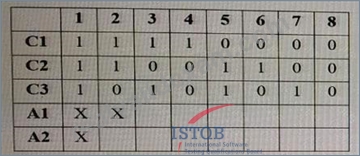
This decision table has been created to test the following specification: Persons that study at a university (C1) and have parents whose total annual income is less than € 30.000 (C2), receive a scholarship In in addition to these qualifications, if they also live away from home (C3), they receive an addition to their scholarship (A2) How many cases are left when this decision table is collapsed?
- A. 0
- B. 1
- C. 2
- D. 3
Answer: A
Explanation:
Two cases are left when this decision table is collapsed. A decision table is a technique that shows the combinations of conditions and actions for a given scenario. A decision table that is collapsed eliminates the combinations that are invalid or impossible, such as having a scholarship without meeting the qualifications.
The two valid cases for this scenario are:
* C1 = Y, C2 = Y, C3 = Y, A1 = Y, A2 = Y
* C1 = Y, C2 = Y, C3 = N, A1 = Y, A2 = N
Verified References: [ISTQB Certified Tester Advanced Level Test Analyst CTAL-TA], Section 3.3.1, page 37.
NEW QUESTION # 52
An airline provides self-service check-in kiosks for passengers. The following use case has been created for the self-service check-in process.
Coverage Rules:
* One test case should be designed for the basic behavior
* One test case should be designed for each alternate and error handling behavior Applying these rules to the Self Service Check-in Use Case, how many test cases should be designed?
SELECT ONE OPTION
- A. 0
- B. 1
- C. 2
- D. 3
Answer: A
Explanation:
Comprehensive and Detailed in Depth Explanation:
To determine the number of test cases, we follow the coverage rules:
* Basic Behavior:One test case for the standard check-in process without errors (1 test case).
* Error Handling (Exceptions):There are 7 exceptions listed (E1 to E7), and each needs a separate test case.
Hence, the total number of test cases is1 (basic) + 7 (error scenarios) = 8.
Therefore, the correct answer isB (8).
NEW QUESTION # 53
You are testing a hospital patient management system that has undergone a release including an improved user interface and changes to meet new regulatory requirements. You are a Test Analyst working with a Technical Test Analyst.
Which of the following requirements MOST align with your responsibilities as a Test Analyst?
* R01:New and amended patient data can be successfully read and processed by receiving hospital department systems
* R02:Patient data will be transmitted and received by hospital department systems within ten seconds of entry
* R03:Patient data transmitted to other hospital department systems will remain secure and cannot be accessed by unauthorized third parties
* R04:High volumes of data can be successfully received and processed while the user interface is being used
* R05:The new user interface is appropriate for the needs of all hospital administrator roles SELECT ONE OPTION
- A. R02, R03
- B. R01, R05
- C. R03, R04
- D. R01, R02
Answer: B
Explanation:
Comprehensive and Detailed in Depth Explanation:
As aTest Analyst, the focus is primarily onfunctional and usability aspects:
* R01:Validates that the new or amended data can be correctly read and processed - this is afunctional requirement.
* R05:Evaluates whether the newuser interfacemeets the needs of hospital administrators - this is related tousability.
* The remaining requirements (R02, R03, R04) involveperformance, security, and load testing, which are more suited for theTechnical Test Analyst.
Therefore, the correct answer isD (R01, R05).
NEW QUESTION # 54
REQ1 a sun cancer warning system shall produce a daily score sheet based on the number of hours expose to the sun and the intensity of sun radiation.
REQ2 The number of hours exposed to the sun shall be categorized in A (below 2), B (2 to 4 hours) or C (more than 4 hours) REQ3 The intensity of sun radiation shall be labelled as low, medium, high, or extreme.
Based on the requirements stated above a Test Analyst has defined the following three test cases:
How many test conditions to be identified from requirements REQ2 and REQ3, are NOT covered by the three test cases:
- A. 0
- B. 1
- C. 2
- D. 3
Answer: C
Explanation:
Four test conditions to be identified from requirements REQ2 and REQ3 are not covered by the three test cases. A test condition is an item or event of a component or systemthat could be verified by one or more test cases, such as a function, transaction, feature, quality attribute, or structural element. The test conditions to be identified from REQ2 and REQ3 are:
* Number of hours exposed to the sun = A
* Number of hours exposed to the sun = B
* Number of hours exposed to the sun = C
* Intensity of sun radiation = low
* Intensity of sun radiation = medium
* Intensity of sun radiation = high
* Intensity of sun radiation = extreme
The test conditions that are not covered by the three test cases are:
* Number of hours exposed to the sun = A
* Intensity of sun radiation = low
* Intensity of sun radiation = high
* Intensity of sun radiation = extreme
Verified References: [ISTQB Certified Tester Advanced Level Test Analyst CTAL-TA], Section 2.2.1, page 21.
NEW QUESTION # 55
You are testing a hospital patient management system after a change to the patient capture application.
You are running interoperability tests. Which TWO of the following are NOT interoperability defects?
a) The patient name field is truncated on one of the receiving department systems b) Hospital administrators find the new patient-capture application screens difficult to navigate c) Two department systems are unable to recognise the format of international telephone numbers for foreign patients d) Existing patient data takes too long to retrieve by the patient-capture application e) There are spelling errors in the field names on some screens SELECT ONE OPTION
- A. b, d
- B. c, e
- C. a, b
- D. a, c
Answer: A
Explanation:
Comprehensive and Detailed in Depth Explanation:
Interoperability testingverifies that different systems can work together and correctly exchange data.
* a) Truncated patient name:An interoperability defect as it indicates incorrect data handling between systems.
* b) Difficult navigation:Ausability defect, not related to system interoperability.
* c) Incorrect phone number format recognition:An interoperability defect because it affects data exchange.
* d) Slow data retrieval:Aperformance defect, not related to system interaction.
* e) Spelling errors in field names:Ausability or user interface defect, not interoperability.
Therefore, the correct answer isD (b, d).
NEW QUESTION # 56
Which statement BEST describes the activities performed by the Test Analyst during the TEST ANALYSIS stage of the test process?
SELECT ONE OPTION
- A. Producing high-level test cases and defining the supporting test data
- B. Applying test techniques to reduce the likelihood of omitting important test conditions
- C. Ensuring that multiple product risks are covered by one test condition to reduce maintenance overheads
- D. Defining the start and completion dates for the test analysis stage
Answer: B
Explanation:
Comprehensive and Detailed in Depth Explanation:
According to the ISTQB CTAL-TTA syllabus, theTest Analysisstage involves identifying test conditions based on test basis documentation, requirements, and risk analysis. The primary focus is on analyzing the test basis to identify what needs to be tested. Applying test techniques during this stage helps reduce the risk of missing important test conditions. Therefore, Option A correctly states that test techniques are applied to minimize the risk of omitting important conditions.
Option B is incorrect because combining multiple product risks into one test condition can lead to overlooking specific risks, which contradicts the goal of thorough test analysis.
Option C is incorrect as defining dates is part of planning, not analysis.
Option D is incorrect because producing high-level test cases and defining data are tasks related to test design, which follows test analysis.
This detailed breakdown aligns with the ISTQB syllabus, emphasizing that test analysis primarily deals with identifying test conditions through the application of test techniques.
NEW QUESTION # 57
The following document has been produced as part of the replacement of an internal Customer Relationship Management (CRM) application. The replacement application should not differ from the current CRM application, and the documentation reflects this aspiration, with seven specific requirements listed.
The requirements will be reviewed using a standard checklist:
a. Requirements should be testable
b. Each requirement should be consistent with other requirements
c. Each requirement should be unambiguous
d. Each requirement should have a unique identifier
e. Documents should be versioned, dated, and the author specified
Which checklist items would identify issues in this requirements document?
SELECT ONE OPTION
- A. b, d
- B. a, c
- C. b, e
- D. d, e
Answer: A
Explanation:
Comprehensive and Detailed in Depth Explanation:
* Requirement Testability (a):The requirements are testable as they specify expected behavior, such as response time (4 seconds) and SSO control.
* Consistency (b):There is inconsistency, as one requirement states no changes to screens, but another mentions a new data item for FCA registration.
* Ambiguity (c):The requirements are clear in terms of what they specify.
* Unique Identification (d):The requirements are listed as bullet points without unique identifiers, violating this criterion.
* Versioning and Author (e):The document includes a version number, date, and author.
Therefore, the correct answer isD (b, d).
NEW QUESTION # 58
Supercar is an online vehicle sales website specialising in a single manufacturer's Sports Utility Vehicles (SUVs) and saloons. A vehicle has two key elements, power unit and body style. The manufacturer offers three choices of power unit: petrol, diesel and hybrid. There are 3 mam body styles Saloon, Hatchback and SUV SUVs only come as petrol and diesel options Hybrid is available for Hatchback only. The site will allow an order to be processed if at least one of the chosen vehicle configurations is in stock, otherwise a message will be displayed asking the user to try again later As a Test Analyst you are asked to review the Supercar specification before starting to design the corresponding usability test cases. Which of the comments below should you make?
- A. It is not clear which message will be displayed when the car is "out of stock"
- B. I have no comments, specification looks OK
- C. Dependencies between power unit and body style are ambiguous
- D. Boundaries for stock levels are ambiguous.
Answer: D
Explanation:
The comment that should be made about the Supercar specification is that boundaries for stock levels are ambiguous. The specification states that the site will allow an order to be processed if at least one of the chosen vehicle configurations is in stock, but it does not define what constitutes "in stock" or how many units are available for each configuration. This makes the specification unclear and inconsistent, as it does not provide enough information for testing or implementation. Verified References: [ISTQB Certified Tester Advanced Level Test Analyst CTAL-TA], Section 2.3.1, page 23.
NEW QUESTION # 59
Consider the following user story: As a student, I want to be able to buy a parking pass (priority: high) Acceptance criteria
- The student will not receive the parking pass if the payment is insufficient.
- Only registered students can buy a parking pass.
- The student can only buy one parking pass each month.
Which of the following checklist items would result in finding a defect for the user story?
- A. Is the story prioritized?
- B. Does the story follow the commonly used format "As a < >, I want < > so that < >"?
- C. Is the story written from the view of the person who requested it?
- D. Are the acceptance criteria defined and testable?
Answer: D
Explanation:
The checklist item that would result in finding a defect for the user story is "Are the acceptance criteria defined and testable?". The acceptance criteria are the conditions that a system or component must satisfy in order to be accepted by a user, customer, or other authorized entity. The acceptance criteria should be defined and testable for each user story, as they provide the basis for designing and executing test cases. The user story in this question does not have any acceptance criteria defined, which is a defect that needs to be addressed. Verified References: [ISTQB Certified Tester Advanced Level Test Analyst CTAL-TA], Section
2.4.1, page 25.
NEW QUESTION # 60
Based on the tax system specification as described below, using boundary value analysis, which would be the best test set to explicitly test on single boundary value fully?
Tax system
A tax system needs to be updated due to new legislation. For a person with a salary of less than € 20 000 and who is married, the tax needs to be recalculated.
If a person has at least three and less than six children, an additional 10% reduction is applicable.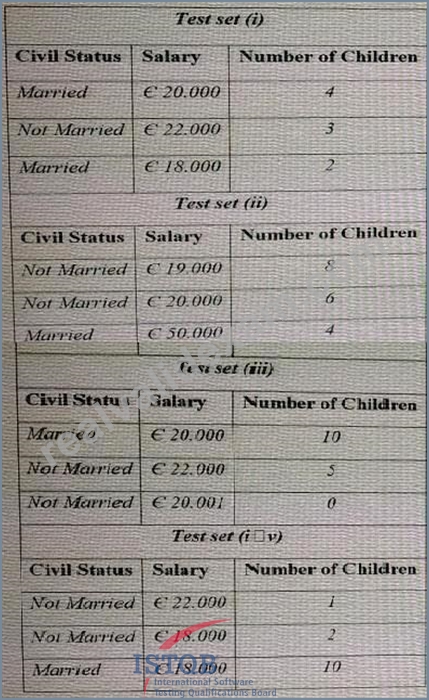
- A. Test set (ii)
- B. Test set (i)
- C. Test set (iv)
- D. Test set (iii)
Answer: A
Explanation:
The test set B is the best test set to explicitly test on single boundary value fully, using boundary value analysis. Boundary value analysis is a technique that tests the values at or near the boundaries of an input domain. The boundaries for this scenario are:
* Salary less than €20 000
* Number of children at least three and less than six
The test set B tests the boundary values of each boundary (€19 999, €20 000, three children, six children) and one value inside each boundary (€19 998, €20 001, four children). Verified References: [ISTQB Certified Tester Advanced Level Test Analyst CTAL-TA], Section 3.2.2, page 35.
NEW QUESTION # 61
Which of the following is an appropriate task for the Test Analyst to perform during the test execution phase?
- A. Finalizing test data and test environments
- B. Creating a test execution schedule
- C. Analysing anomalies to establish their likely causes
- D. Creating automated tests
Answer: C
Explanation:
Analysing anomalies to establish their likely causes is an appropriate task for the Test Analyst to perform during the test execution phase, as it involves applying defect analysis techniques to identify the root causes of defects and suggest possible solutions. Creating a test execution schedule, creating automated tests, and finalizing test data and test environments are tasks that belong to other phases of testing, such as test planning, test implementation, and test preparation. Verified References: [ISTQB Certified Tester Advanced Level Test Analyst CTAL-TA], Section 4.1.1, page 43.
NEW QUESTION # 62
How many cases are required to test the tax system specification as described below, using a decision table which is not collapsed?
Tax system
A tax system needs to be updated due to new legislation. For a person with a salary of less than € 20.000 and who is married, the tax needs to be recalculated. If the person also has more than two and less than five children, an additional 10% reduction is applicable.
- A. 0
- B. 1
- C. 2
- D. 3
Answer: B
Explanation:
Eight cases are required to test the tax system specification using a decision table that is not collapsed. A decision table is a technique that shows the combinations of conditions and actions for a given scenario. A decision table that is not collapsed contains all possible combinations of conditions and actions, regardless of whether they are valid or not. The conditions for this scenario are:
* Salary less than €20 000
* Married
* Number of children more than two and less than five
The number of cases is equal to the number of possible combinations of these conditions, which is 2^3 = 8.
Verified References: [ISTQB Certified Tester Advanced Level Test Analyst CTAL-TA], Section 3.3.1, page 37.
NEW QUESTION # 63
......
Test Engine to Practice ISTQB-CTAL-TA Test Questions: https://actualtests.realvalidexam.com/ISTQB-CTAL-TA-real-exam-dumps.html
