
Get Latest Apr-2026 Real ISO-14001-Lead-Auditor Exam Questions and Answers FREE
Truly Beneficial For Your PECB Exam (Updated 42 Questions)
PECB ISO-14001-Lead-Auditor Exam Syllabus Topics:
| Topic | Details |
|---|---|
| Topic 1 |
|
| Topic 2 |
|
| Topic 3 |
|
| Topic 4 |
|
| Topic 5 |
|
NEW QUESTION # 25
You are leading a recertification audit of XM, a manufacturer of cosmetics products. After the initial certification, XM moved to another site.
After the opening meeting, you are visiting the new site with the production manager (PM). The dialogue is as follows:
You: It seems that you are doing some work in the right-hand corner of the site.
PM: Yes, when we moved to this site, there was a very old, three-stories high building; it was almost empty, and we decided to demolish it and to build a new office for the administrative personnel. DEMO services are doing the job, which is almost over.
You: Do you know what the old building was used for?
PM: I was told that it was a warehouse for chemical storage, including a laboratory and toilets for the personnel. It had also a chimney, I do not know what for.
You: Did you consider it necessary to refer to some parts of the EMS for this work?
PM: No, we were busy moving all equipment and materials to the new site, we did not have time to care about something that was going to disappear.
Which four audit trail issues would you follow?
- A. Regulatory approval for DEMO's activities
- B. DEMO's environmental policy
- C. Business information on DEMO
- D. XM's supervision of DEMO when doing the work
- E. DEMO's quality policy
- F. XM's contract with DEMO to conduct the work
- G. Environmental impacts related to the demolition
- H. Audit DEMO's head office personnel
Answer: A,D,F,G
Explanation:
According to ISO 14001:2015:
Clause 6.1.2 & 6.1.4 (Environmental aspects and planning actions): demolition impacts must be identified and controlled (C).
Clause 8.1 (Operational planning and control): control of outsourced processes (supervision and contract requirements) (B, E).
Clause 9.1.2 (Compliance obligations): regulatory approvals for demolition (H).
The subcontractor's internal policies (A, D, F, G) are generally not part of XM's EMS obligations.
Reference: ISO 14001:2015 Clauses 6.1.2, 6.1.4, 8.1, 9.1.2.
NEW QUESTION # 26
Which one of the following options describes the main purpose of a Stage 1 audit?
- A. To get to know the organisation
- B. To check for legal compliance by the organisation
- C. To compile the audit plan
- D. To determine readiness for Stage 2
Answer: D
Explanation:
According to ISO/IEC 17021-1:2015 Clause 9.3.2.1:
The main purpose of Stage 1 is:
"To evaluate the client's management system documentation and preparedness for Stage 2 audit." This includes reviewing:
The status of implementation.
The client's understanding of requirements.
Readiness for the Stage 2 audit.
While the auditor will learn about the organization (B) and may draft plans (C), these are supporting activities. Legal compliance checks (D) occur in Stage 2.
Reference: ISO/IEC 17021-1:2015 Clause 9.3.2.1.
NEW QUESTION # 27
An oil organisation has a natural gas treatment plant on land crossed by several small rivers. On one particular day, after heavy rainfall for 48 hours, some of those rivers burst their banks and flooded the water treatment facilities of the plant. The oil-contaminated water reached some scarcely populated areas nearby.
Soon after, an internal audit was carried out to particularly analyse this event that was considered a nonconformity. There were no records of such heavy rainfall in the past 200 years.
Which three of the following actions are 'corrections'?
- A. Send the contaminated land for processing
- B. Clean up the houses of the persons affected
- C. Offer loans to the persons affected to build new houses far from the plant
- D. Relocate the water treatment plant to lower ground
- E. Revise the existing emergency plan
- F. Clean up the affected land
- G. Build up some additional protection to the water treatment plant
- H. Reinforce the riverbanks with cement
Answer: A,B,F
NEW QUESTION # 28
A small services organisation has been contracted to handle the disposal of waste for a local hospital. You are an auditor conducting a Stage 2 audit of the care home to ISO 14001. You are reviewing the contract with the Service Manager (SM). An addendum to the contract only requires that biological waste is disposed of in the most environmentally friendly way, without reference to any regulatory requirements.
You: How was the waste disposal plan for the contract developed?
SM: We have a basic template that covers the materials, labour requirements and methods to be employed.
Some of that is specified by the contractor.
You: How does the plan deal with specific items like biological waste, which are included in the contract and can pose biological hazards to the environment?
SM: The basic plan covers general waste, but we have an addendum that covers biological waste.
You: Are you aware of the regulatory requirements for waste disposal standards in hospitals?
SM: Yes but we depend on the contractor to look after that side of things.
You raise a nonconformity against section 8.1.d of ISO 14001.
At the Stage 2 closing meeting of the audit, the EMS Manager objects to the nonconformity raised and asks for it to be withdrawn. He insists that they meet all the regulations.
Choose one of the options that the audit team leader should take in response to the request.
- A. Offer to downgrade the nonconformity to an opportunity for improvement if the organisation can prove its compliance with regulations.
- B. Confirm that it is a valid nonconformity supported by a lack of evidence for meeting the requirement.
- C. Consult with the auditor who raised the nonconformity and ask whether he will agree to withdraw it.
- D. Advise that the nonconformity will be reconsidered after the meeting.
Answer: B
NEW QUESTION # 29
Which two of the following phrases would apply to "audit criteria"?
- A. Auditor competence
- B. Audit conclusions
- C. Financial objectives
- D. Nonconformity report
- E. Management policy
- F. ISO 14001 requirements
Answer: E,F
Explanation:
According to ISO 19011:2018 Clause 3.3 (Terms and definitions):
Audit criteria are defined as:
"Set of policies, procedures or requirements used as a reference against which objective evidence is compared." ISO 14001 requirements (F) and the organization's own management policy (A) are valid audit criteria.
Nonconformity report (C) and audit conclusions (D) are audit outputs, not criteria.
Financial objectives (B) and auditor competence (E) are not used as audit criteria.
Reference: ISO 19011:2018 Clause 3.3; ISO 14001:2015 Clause 5.2.
NEW QUESTION # 30
An organisation has ISO 14001 EMS certification from a third-party certification body. Which one of the following represents an advantage of having accredited certification?
- A. An increase in the number of clients.
- B. Recognition of the credibility of the certification process.
- C. An increase in the marketing price of the organisation's products.
- D. Clarity of the audit report.
Answer: B
Explanation:
Accredited certification under ISO 14001 refers to certification that has been issued by a certification body that is itself accredited by a national accreditation body. This provides formal recognition that the certification body is competent to perform audits and issue certifications in accordance with ISO/IEC 17021 standards.
According to guidance in ISO 14001 Lead Auditor training materials and ISO/IEC 17021, one of the key benefits of accredited certification is:
"Recognition of the credibility, impartiality, and technical competence of the certification process and the certification body issuing the certificate." This recognition:
Increases stakeholder confidence (e.g., regulators, clients, the public), Supports market access and tender qualifications, Confirms that audits are performed in accordance with international best practices.
Option D correctly reflects the most strategic and system-level benefit of accredited certification.
The other options (A, B, and C) may result indirectly or are not directly linked to the purpose of accreditation.
Reference:
ISO/IEC 17021:2015 - Requirements for bodies providing audit and certification of management systems ISO 14001 Lead Auditor Course Guide - Module on Certification and Accreditation ISO 14001:2015 - Clause 3.1.1 & 3.1.2 (definition of EMS and system credibility)
NEW QUESTION # 31
A group of 22 Italian restaurants in downtown San Francisco (US) established an EMS following the requirements of ISO 14001. You are performing an internal audit before the fourth certification cycle. The audit plan included an audit of the General Manager (GM) as the last interview before the closing meeting.
During the interview with the GM, you audit clause 10.3 (Continual improvement). The dialogue is as follows.
You: Could you please tell me how did you improve the EMS to enhance environmental performance (Clause
10.3)?
GM: One way to improve the EMS is to improve one or several of its processes. We decided to improve the water-consuming processes in all our branches. We use water in many of our processes (e.g. to wash our kitchens, our cutlery, plates, and glasses, to keep our floors clean). The idea was to review these processes in detail to reduce the amount of water used per customer. Each of the 22 branches sent us their results, we analysed the data and found out that the average water consumption per customer was reduced by 13%; therefore, we improved our environmental performance. We are happy about that.
You: What about the results in each branch?
GM: Have a look at this table: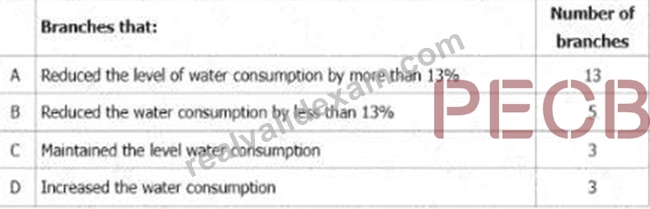
Analysing this table, what would be your decision related to raising nonconformities to clause 10.3? Select two.
- A. I would raise an opportunity for improvement for branches in B, C, and D
- B. I would not raise any nonconformity
- C. I would raise a nonconformity for the whole group
- D. I would raise a nonconformity for branches in D
- E. I would raise a nonconformity for branches in C and D
- F. I would raise a nonconformity for branches in B
Answer: A,D
NEW QUESTION # 32
Showitoff is an organisation specialising in the design and production of wall decorating materials for the domestic market. During an ISO 14001 certification audit of the site, the auditor comes across an open, walled area just outside the maintenance department. It contains various scraps of wood and metal as well as several rusty components. They are lying on an oily floor. When asked about it, the EMS Manager states that he presumes that the materials come from maintenance work.
The auditor interviews the Maintenance Manager in his department. He notes that shelves containing various spares are well labelled and neatly stacked. He asked about the "dump" outside and is told that it contains some excess materials that the Manager likes to keep in case they come in handy at some stage. The auditor points out that the "dump" might be classed under regulations as a landfill site, which requires an operating licence. The Maintenance Manager is not aware of such a licence.
Which three statements represent good audit practice?
- A. The auditor should congratulate the Maintenance Manager on having a neat and tidy spares store.
- B. The auditor should raise a nonconformity against ISO 14001.
- C. The auditor should ask the Maintenance Manager to clean up the "dump".
- D. The auditor should refer the organisation to the relevant authorities.
- E. The auditor should advise the organisation to get rid of all the "dumps".
- F. The auditor should consider surveying more areas of the site for other "dumps".
- G. The auditor should check the information given by the Maintenance Manager with the EMS Manager.
- H. The auditor should check whether the organisation has permission to operate a landfill site.
Answer: F,G,H
NEW QUESTION # 33
What are the primary purposes of implementing an EMS based on ISO 14001:2015? Select two.
- A. It enables the organisation to tender for government-funded contracts.
- B. It ensures that organisations operate fully online management systems.
- C. It is used to demonstrate to external parties that the organisation has met all its legal requirements.
- D. It improves the organisation's financial results.
- E. It provides a framework for protecting the environment.
- F. It provides a means by which environmental impacts are addressed at relevant stages of the life cycle.
Answer: E,F
Explanation:
According to ISO 14001:2015 Clause 1 (Scope) and Clause 6.1.2:
Clause 1:
"The purpose of this International Standard is to provide organizations with a framework to protect the environment and respond to changing environmental conditions in balance with socio-economic needs." Clause 6.1.2:
"The organization shall determine the environmental aspects of its activities, products and services that it can control and influence, considering a life cycle perspective." Demonstrating legal compliance (B) is part of the intended outcomes but not the primary purpose.
Tender eligibility (C), financial results (E), and system format (F) are not stated objectives of ISO 14001:2015.
Reference: ISO 14001:2015 Clauses 1, 6.1.2.
NEW QUESTION # 34
During a Stage 1 audit, the EMS Manager asks that the audit includes coverage of a new storage site on the other side of town that they have taken over since the application was made.
Which two of the following actions should the auditor take?
- A. Advise the EMS Manager that the audit scope has been set and the audit will need to proceed as planned.
- B. Determine whether the EMS Management System covers the new site and, if so, proceed with the audit.
- C. Advise the EMS Manager that, within the existing scope, the new site can be included without any problem.
- D. Advise the EMS Manager that an extension of the scope is possible but will have to go through established procedures.
- E. Inform the auditee that the Stage 2 will be changed to include the new site.
- F. Suggest that the EMS Manager cancels the audit contract and reapplies for the new situation.
Answer: B,D
Explanation:
According to ISO/IEC 17021-1:2015 Clause 9.2.2 and 9.3.1:
Scope changes may be accommodated during the certification process, but proper evaluation is required.
The auditor should:
Confirm whether the EMS has been extended to cover the new site (C).
Inform that scope expansion needs to follow formal procedures through the certification body (F).
Simply including the new site without evaluation (A) is incorrect.
The audit plan can be adjusted, but full reassessment (D) is unnecessary unless significant issues arise.
Reference: ISO/IEC 17021-1:2015 Clause 9.2.2, 9.3.1; ISO 14001 Lead Auditor Course Guide.
NEW QUESTION # 35
A chain of 10 paint shops in a city has established an EMS following the requirements of ISO 14001, which was third-party certified 10 years ago. You are performing a second-party audit. The audit plan included an interview with the General Manager (GM). The dialogue was as follows:
You: Hi, good evening, I have seen a well-developed environmental risk assessment process. However, I did not find the identification of emergency situations included in the results of this process. The Environmental Manager (EM) could not provide me with an acceptable answer to this question.
GM: The EM joined us 2 months ago, and he may not know some decisions we made some time ago, when we first certified our EMS. During those days, I met with all 10 supervisors and asked them what the emergencies were that they feared most. They unanimously said: fire. That was it. This is the only emergency we care of. As far as I remember we do not test the plan very often because the supervisors of all our 10 shops know it very well. The auditors of our certification body accepted this. We did not have a fire in the last 10 years.
What evidence would you need to review to determine conformity with ISO 14001 in this scenario? Select six.
- A. More details on whether the risk assessment process was applied to emergencies
- B. Replacements of supervisors of each shop when they are absent (for any reason)
- C. Signage related to health and safety in each shop
- D. Reports of the management reviews
- E. Reports of the last two fire drills you performed
- F. General competence records of all 10 supervisors
- G. Shops that have tested the plan in the last 10 years
- H. Minutes of the meeting with supervisors where a fire was determined as the only emergency situation
- I. Records of the specific fire combat training of workers
- J. Results of the inspection of fire extinguishers
- K. Reports of audits from the certification body
Answer: A,D,E,G,I,J
NEW QUESTION # 36
An internal auditor of a manufacturer of aluminium products for the car industry raised a nonconformity against section 6.2.2 of ISO 14001 in Report IA202. The nonconformity (NC3) stated:
"Top management has not analysed why none of the environmental objectives set for the last year have been met." A third-party auditor reviewing the internal audit process came across the nonconformity and found that no corrective action was documented. The EMS Manager confirmed no action had been taken, but added he expected a number of objectives to be achieved in the next three months so there was no need for further action. He explained in confidence that the organisation was fighting a takeover bid and resources for environmental projects had been cut.
From the information, select three non-conformities options that the auditor could raise to ISO 14001.
- A. 6.2.2 - Actions were not taken to fully implement the environmental objectives set by management
- B. 7.4.3 - Management should communicate the impacts of the takeover on the EMS to the bidders
- C. 7.1 - The top management failed to provide the resources needed to meet the objectives
- D. 9.2.2 - Report IA202 contained a nonconformity (NC3) lacking in necessary detail
- E. 7.4.2 - Staff were not made aware that environmental projects were being scaled back
- F. 6.2.1 - New environmental objectives associated with the takeover should be set
- G. 10.2.a - Management failed to take corrective action to deal with the audit nonconformity
- H. 9.3 - A management review should be undertaken to determine the implications of the takeover on the EMS
Answer: A,C,G
NEW QUESTION # 37
Which two audit characteristics are features of a Stage 1 initial certification audit?
- A. The audit team's recommendation regarding certification is the key outcome of this stage.
- B. Except for a pandemic or other natural disaster, this audit must be performed onsite at the auditee's location.
- C. Reviewing some of the auditee's documentation.
- D. The purpose of this audit is to determine if the EMS is effectively implemented and maintained.
- E. To conduct an analysis of the organisation's environmental system processes to determine compliance obligations.
- F. Gaps in the EMS against the requirements of ISO 14001 are reported as 'areas of concern'.
Answer: C,F
Explanation:
According to ISO/IEC 17021-1:2015 Clause 9.3.2.1:
Stage 1 includes:
Reviewing management system documentation (E).
Identifying areas of concern that could become nonconformities at Stage 2 (C).
Evaluating readiness for Stage 2, but not making certification decisions (D).
Stage 1 focuses on preparedness; Stage 2 evaluates full implementation (F).
Onsite requirement (B) is generally true but flexibility is permitted per IAF MD rules.
Reference: ISO/IEC 17021-1:2015 Clause 9.3.2.1; ISO 14001 Lead Auditor Course Guide.
NEW QUESTION # 38
Which one of the following outcomes of an audit does not require the auditee to respond?
- A. A non-conformity.
- B. A conformity.
- C. An opportunity for improvement.
- D. A diverging opinion concerning the audit evidence.
Answer: B
Explanation:
According to ISO 19011:2018 Clause 3.11 (Audit findings) and Clause 6.4.10:
Audit findings can be conformity, nonconformity, or opportunity for improvement.
A conformity simply confirms that the requirements have been met no further action is required from the auditee.
Nonconformities require corrective actions.
Opportunities for improvement may trigger voluntary action but not mandatory response.
Diverging opinions are handled during the audit but don't require post-audit response unless linked to nonconformity.
Reference: ISO 19011:2018 Clause 3.11, 6.4.10; ISO 14001 Lead Auditor Guide - Audit Findings.
NEW QUESTION # 39
You work for a certification body. In two months, you will have to lead an audit of a pharmaceutical organisation, ABC, that manufactures vaccines to combat a pandemic. When planning the audit team, you select one of the certification body auditors who is professionally qualified in Biochemistry and Pharmacy.
However, she is not fully aware of all legal applicable requirements. You recommend the certification body hire a compliance expert to assist the audit team. In which two clauses of ISO 14001:2015 would you consider that auditors may need the help of the expert?
- A. 9.2 Internal audits
- B. 5.2 Environmental Policy
- C. 9.1.2 Compliance obligations
- D. 7.1 Resources
- E. 4.2 Understanding needs and expectations of interested parties
- F. 5.1 Leadership
Answer: C,E
Explanation:
According to ISO 14001:2015:
Clause 4.2:
The organization must understand the needs and expectations of interested parties, which includes regulatory bodies and applicable legal requirements. Legal expertise may be necessary to fully assess this.
Clause 9.1.2:
The organization must evaluate compliance obligations, which requires understanding applicable legal requirements.
Legal compliance evaluation often requires specialized legal or regulatory knowledge, especially in highly regulated sectors like pharmaceuticals.
Reference: ISO 14001:2015 Clauses 4.2 and 9.1.2.
NEW QUESTION # 40
Sparkle is an organisation that provides mobile car cleaning services at customers' premises. It has been certified to ISO 14001 for some time and has appointed a full-time Environmental Management System Manager. The audit plan during a surveillance audit includes continual improvement and the auditor asks to see the most recent management review meeting minutes.
The minutes indicate that the Environmental Management System Manager reported that the last review of the organisation's environmental legislation register was made three years ago instead of annually as planned in the Environmental Management System. At that time, he asked for finances to employ a legislation expert to update the register but was denied the request by top management on the basis that it was unlikely that many changes to legislation had occurred. No related improvement actions were documented in the minutes.
Based on the scenario, select the two options which best describe the evidence for raising such a non- conformity.
- A. Raise an opportunity for improvement (OI) to reduce damaging emissions.
- B. Extend the audit plan to include the five shops.
- C. Determine if the local authority has been informed that the organisation is exceeding VOC emissions.
- D. The organisation failed to update its legislation register following the planned frequency of review.
- E. Recommend that staff in the five shops should have medical check-ups due to air pollution.
- F. Evaluate whether the process for measuring environmental performance is effective.
Answer: A,D
NEW QUESTION # 41
......
ISO-14001-Lead-Auditor dumps Free Test Engine Verified By It Certified Experts: https://actualtests.realvalidexam.com/ISO-14001-Lead-Auditor-real-exam-dumps.html
