
CIPS L4M5 Certification Exam Dumps with 387 Practice Test Questions
New L4M5 Exam Dumps with High Passing Rate
CIPS L4M5 Exam Syllabus Topics:
| Topic | Details |
|---|---|
| Topic 1 |
|
| Topic 2 |
|
| Topic 3 |
|
| Topic 4 |
|
| Topic 5 |
|
| Topic 6 |
|
| Topic 7 |
|
| Topic 8 |
|
| Topic 9 |
|
NEW QUESTION # 128
An adversarial style of negotiation is appropriate when the buyer has greater bargaining power. In what other situation may the buyer adopt this style?
- A. In a market full of alternative sources and substitute products
- B. When the supplier is a monopolist and holds most of the power
- C. Where there is a single sourcing strategy with one supplier retained
- D. In a market where buyers compete for fewer supply sources
Answer: A
Explanation:
Adversarial (win-lose) negotiation is viable when buyers can leverage abundant alternatives and substitutes, reducing supplier power. In such cases, buyers can adopt tough tactics, knowing they can switch suppliers if necessary. By contrast, limited supply, single sourcing, or monopolist suppliers constrain buyer power, making adversarial strategies risky and often ineffective. CIPS stresses that negotiation style must be matched to market conditions and the power balance.
Reference: CIPS L4M5 (2nd ed.), LO 1.1 - Adversarial negotiation: when power asymmetry favours the buyer.
NEW QUESTION # 129
Which of the following is the first step in the development of negotiation strategies?
- A. Determining your BATNA
- B. Developing scenarios around possible options
- C. Defining overarching objectives
- D. Recognising TOP's needs and wants
Answer: C
Explanation:
:
Developing specific negotiation strategies in areas where risk or spend is high involves analysing a wide range of objectives and variables within the context of the organisation's business requirements. The first stage in any negotiation preparation is to define your overall objectives which may be related to a single variable such as price in the case of a standardised requirement, or many variables in the case of capital equipment. Your negotiating strategies and tactics will all be focused on achieving overall objectives.
NEW QUESTION # 130
A procurement professional is preparing for a negotiation with supplier. She is setting targets for price which her company is seeking to achieve. Which of the following acronyms can help her identify limits before engaging in the negotiation?
- A. PPCA
- B. RAQSCI
- C. TIMWOOD
- D. MIL
Answer: D
Explanation:
:
MIL criteria indicate 3 limits that negotiator should establish:
M - Must achieve: minimum target/maximum you can concede on this point; the mandatory requirement or fall back position I - Intend to achieve: realistic target you are aiming for on this point L - Like to achieve: stretch target to achieve on this point.
PPCA is purchase cost analysis
TIMWOOD indicates 7 types of waste in Lean principles
The RAQSCI model is a mnemonic summary of a business model used to define and structure business requirements
NEW QUESTION # 131
In a detailed cost breakdown, a company has a salary cost of 9%, raw materials cost 51% and overheads cost
24%. Which of the following represents themark-up of that company?
- A. Approximately 116%
- B. Approximately 19%
- C. Approximately 16%
- D. Approximately 84%
Answer: B
Explanation:
Explanation
Mark-up is the amount added to the cost of an item to get to its selling price and is expressed as a percentage.
Mark-up(%) = (Price - Cost) / Cost x 100
= (100 - 9 - 51 - 24) / (9 +51 +24) x 100 = 16 / 84 x 100 = 19.04%
LO 2, AC 2.1
NEW QUESTION # 132
Sumitomo Rubber Industries (SRI) is a Japan-based tyre manufacturer. In order to increase production, SRI is sourcing rubber from Southeast Asian firms. Which of the following micro factors are most likely to shift the balance of power to supplier? Select TWO that apply
- A. Costs of changing suppliers are high
- B. Rubber from different suppliers is virtually similar
- C. There are no close substitutes for rubber
- D. SRI sets up its own rubber plantation
- E. SRI's purchase amount makes significant proportion of supplier revenue
Answer: A,C
Explanation:
There are many factors that can influence the balance of power in a negotiation. These factors are classified into 3 levels:
Macro level: STEEPLE framework: social, technological, economic, environment, political, legal and ethical Micro level: Porter's five forces: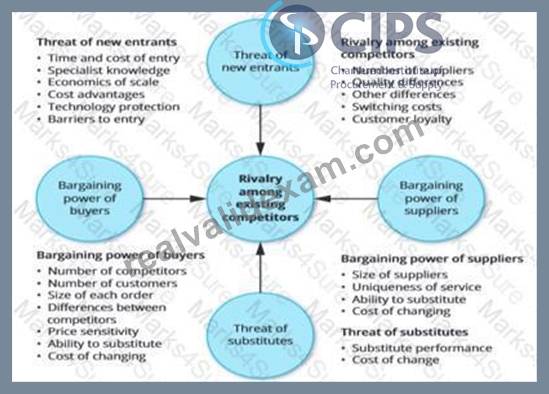
Diagram Description automatically generated
One-to-one buyer-supplier dynamics.
The question asks about the micro factors that increases supplier's bargaining power. Among 5 answers, only
2 are likely to increase buyer's power:
There are no close substitutes for rubber: the buyer has to buy rubber, not any other material.
Costs of changing suppliers are high: buyer entails a large barrier if they want to switch supplier.
Other answers cannot be correct because:
SRI sets up its own rubber plantation: Buyer secures its own supply
SRI's purchase amount makes significant proportion of supplier revenue: Suppliers are reliant on buyer. If the buyer stops buying from them, they can face serious cash flow problems Rubber from different suppliers is virtually similar: undifferentiated product would shift the power balance towards buyer.
NEW QUESTION # 133
Whenimplementing value analysis or value engineering, which of the following acronyms reminds both buyer and supplier of ideas on removal, substitution and design-out of cost elements?
- A. STOPS WASTE
- B. SAMOA
- C. OWN-IT
- D. SMART
Answer: A
Explanation:
Ray Carter coined the mnemonic STOPS WASTE to remind buyers of 10 cost-reduction ideas they can ask for themselves and their suppliers in any situation when considering a key purchase input. Stop Waste by:
Standardisation - is there a standard specification?
Transportation - is the inbound transport classification appropriate
Over-engineered - is the specification too tight?
Packaging - can packaging be reduced or eliminated?
Substitutes - is there a cheaper substitute material
Weight - is there opportunity to reduce weight of the product?
Any unnecessary processing - is there any unnecessary design or feature?
Supplier's input - are suppliers able to assist with the cost reduction To make - is it more economical to make or buy?
Eliminate - if no one uses the feature, can it be eliminated?
SAMOA is a useful acronym for checking and testing the information gathered from the Internet:
Source
Audience
Methodology
Objectivity
Accuracy
OWN-IT is acronym for 5 steps in the process of collecting and analysing the data andinformation needed in any field:
Outline
Wide search
Narrow search
Increase your stockpile of information
Transform your stockpile into new knowledge
A SMART goal is used to help guide goal setting. SMART is an acronym that stands for Specific,Measurable, Achievable, Realistic, and Time-bound.
NEW QUESTION # 134
In what circumstances is the bargaining power of suppliers likely to be high, in relation to buyer power?
Select the THREE that apply:
- A. The number of suppliers is limited
- B. The supplier has highly specialized machinery
- C. The demand is not urgent
- D. The buying firm is large in comparison to the supplier
- E. The volume required is low
- F. The product the buyer requires is undifferentiated
Answer: A,B,E
NEW QUESTION # 135
End users are the only stakeholders that are involved in the preparation of a negotiation. Is this statement true?
- A. No, because end-users are external stakeholders
- B. Yes, because only end-users understand their demand
- C. No, because budget holders also play an important role
- D. Yes, because end-users have greaterexpert power
Answer: C
Explanation:
Explanation
Commercial negotiation objectives should bedriven by the business needs of the organisation. Organisations are made up of different stakeholder groups, some of whom may have different, even conflicting objectives.
From a negotiation perspective, stakeholders can be defined as persons or groups thathave interest (or stake) in the outcome of the negotiation you are leading or participating in.
CIPS distinguishes between 3 sets of stakeholders:
- Internal stakeholders
- Connected stakeholders
- External stakeholders
End-users are examples of internalstakeholders. They are the people who will benefit from the purchase of a product or service. However, their interest may conflict with other groups, i.e. the budget controllers whose objective is minimising the expense. In negotiation perspective, procurement should involve different groups of stakeholder.
LO 1, AC 1.1
NEW QUESTION # 136
Which of the following is potentially a major source of conflict?
- A. Power imbalance
- B. Teamwork
- C. Information gathering
- D. Shared goals and values
Answer: A
Explanation:
Reference: CIPS L4M5 Study Guide, Section 1.3 - Sources of Conflict in Negotiation
NEW QUESTION # 137
Which characteristics are likely to feature within an integrative negotiation?
* Maximising the other party's outcome to enhance relationships
* Maximising joint outcomes
* Short-term focus
* Pursuit of goals held jointly with other party
- A. 2 and 4 only
- B. 1 and 3 only
- C. 3 and 4 only
- D. 1 and 2 only
Answer: A
Explanation:
Integrative negotiationfocuses onmutual gainand long-term collaboration. It seeks tomaximize joint outcomesand encourages parties to align interests andpursue shared goals. This contrasts with distributive tactics that prioritize individual wins and short-term gains.
"Integrative negotiations aim to create outcomes where both parties benefit. Shared problem-solving, information exchange, and joint goal pursuit are central features of this approach." (L4M5 Commercial Negotiation, 2nd edition, Section 1.1 - Principles of Integrative Negotiation)
NEW QUESTION # 138
Which of the following are most likely to be sources of conflict that can emerge from the process of commercial negotiations? Select TWO that apply.
- A. Differences in culture
- B. Standard terms and conditions
- C. Line of the best fits
- D. Types of purchase
- E. Differences in conflict management style
Answer: A,E
Explanation:
There are multiple sources of divergent positions that can arise in situations where money is exchange for goods and services. There are 2 different types of sources. Those that arise from the content or subject matter of the negotiation (what is being negotiated) and those that arise from the process of negotiation (how it is being negotiated).
Sources of divergent positions - the process of negotiation:
Table Description automatically generated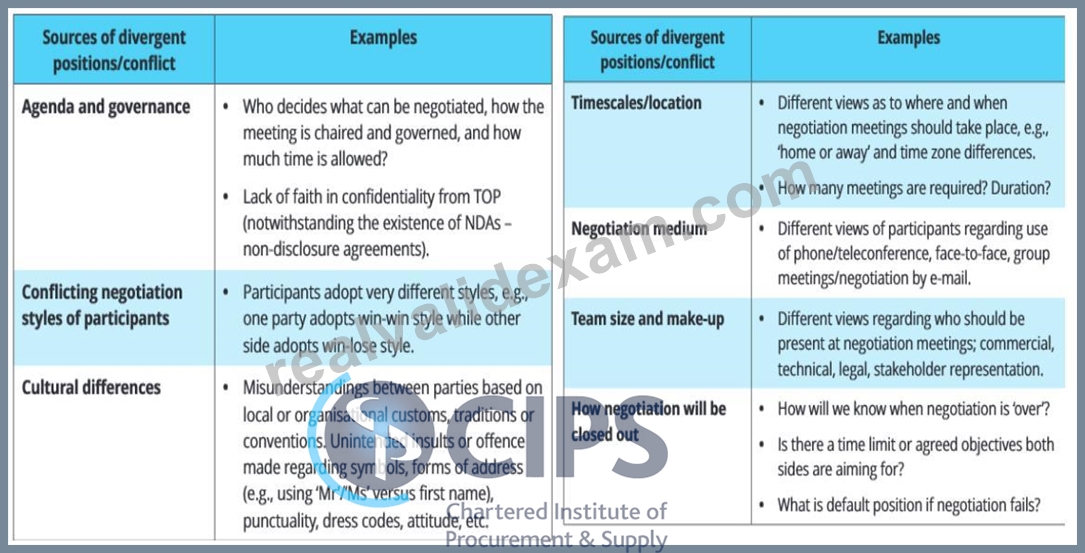
Line of best fits is the line that goes approximately through the middle of the data points with an equal number of data points above and below it. Line of best fits is a method of calculating medium value instatistics.
Standard terms and conditions are basic terms and conditions of business governing transactions that do not have a definitive contract, usually designed to be included in form documents such as orders. While there may be conflicts regarding standard terms and conditions, they are about the content of negotiation, not the process.
Type of purchase: when buying organisation makes an decision to purchase an item, a buyer is faced with three possible scenarios. The item to be bought could be a straight re-buy, a modified re-buy or a new purchase. Decision on type of purchase is purely an internal decision.
NEW QUESTION # 139
Can a party gain huge advantages in negotiation from setting room layout?
- A. Yes, because the host can freely manipulate the other party's mind through setting room layout
- B. Yes, because the other party can capitulate to the host
- C. No, because the advantages gained from manipulating room layout are short-lived
- D. No, because room layout contributes nothing to the negotiation outcomes
Answer: C
Explanation:
:
Essentially, for trained negotiators under most circumstances, the physical locations of negotiations and the room layout should not make much difference to the outcomes of the meeting. It is reasonable to assume that most commercial negotiations are based at least initially on a principled- or pragmatic-type approach. It is arguable also that any advantage gained through intentionally creating an uncomfortable environment to put short-term pressure on TOP is likely to be short-lived as TOP will likely reflect on this later and seek means to get even.
NEW QUESTION # 140
Which of the following is definition of elasticity of demand in microeconomics?
- A. The percentage change in the quantity demanded divided by the percentage change in income
- B. The percentage change in income divided by the percentage change in the quantity demanded
- C. The percentage change in the quantity demanded of a good divided by the percentage change in the price of that good
- D. The percentage change in price of a good divided by the percentage change in the quantity demanded of that good.
Answer: C
Explanation:
Elasticity refers to the responsiveness of quantity demanded or quantity supplied to a change in price or another factor:
The price of a product can be described as being elastic if a small change in price leads to a big change in demand.
The price of a product can be described as being inelastic if a big change in price leads to a small change in demand.
The formulae of elasticity of demand is known as the following:
Text Description automatically generated with low confidence
NEW QUESTION # 141
A procurement manager is about to lead an important negotiation with a new IT supplier and has insisted the first meeting takes place at the buying organisation's office. Will this give one party an advantage?
- A. Yes-the buyer, as the supplier is unfamiliar with the premises and may be less confident
- B. No-location is not important and does not impact leverage for either party
- C. No-the costs, time, and resource spent in attending by both parties will be equal
- D. Yes-the supplier, as they can take time away from their usual workplace
Answer: A
Explanation:
Contextual (environmental) power includes home-ground advantage, control of the venue, access to colleagues and data, and comfort with logistics-all of which can tilt confidence and leverage toward the host (the buyer).
Reference: CIPS L4M5 (2nd ed.), LO 3.1 - Sources of power in negotiation (context/venue, informational, organisational, personal).
NEW QUESTION # 142
IHL has beensupplying to XYZ Ltd for months. XYZ Ltd procurement manager Diana realises that the IHL's input prices are dropping and this is a good time to re-negotiate the price of the contract. She invites IHL representative to XYZ headquarter to make a bargain on the current price. At the opening stage of the negotiation, Diana requests a 10% reduction in price with an increase in volume purchased.
Is Diana's action appropriate in the opening phase?
- A. Yes, because the negotiation should be done as quick as possible
- B. No, because Diana should state exactly the increasing quantity
- C. No, because Diana has put the markers down too soon
- D. Yes, because Diana's proposal is a fair trade for both parties
Answer: C
Explanation:
The opening stage of the negotiation coversthe very first few minutes when the parties meet and greet each other and are seated in the negotiation room in preparation for the main event.
Typical behaviours at the opening stage: 'dos' and 'don'ts'
Do's
Be punctual and well presented (welcome theirarrival)
Break the ice with small talks
Start the conditioning process
Check authority
Check agenda
Consider using visual aid to set out key objectives or make key points
Don'ts
Use strong, pushy, cold or tough style at the opening
Put down marker at thisstage
Criticise other organisations/TOP's previous contacts/third parties.
In this scenario, Diana has made her proposal right at the opening stage. This is an example of 'don'ts'. Good negotiators are very careful about 'red lines'. If she puts such barrier up too early, the supplier may not try to look for more creative solutions later in the negotiation.
NEW QUESTION # 143
According to Fiona Dent and Mike Brent, which of the following are characteristics of Push approach? Select TWO that apply.
- A. Inspirational
- B. Persuasion
- C. Seeking commitment
- D. Collaborative
- E. Directive
Answer: B,E
Explanation:
:
According to the book 'Influencing: Skills and techniques for business success' by Fiona Dent and Mike Brent, there are two major influencing styles. Push tends to be directive. It tells, and is clear and resolute, but needs to be employed in situations where firmness is required because of difficulties that exist or weakness is evident. Pull is more participatory and collaborative. It seeks to incorporate everyone's perspective. It can appear wishy-washy if not skilfully employed. That approach should be followed which is most likely to secure commitment and not mere compliance.
The two divisions can be further divided into four style categories: directive; persuasive reasoning; collaborative - team oriented, people oriented to inspire them with a vision. The directive style relies on your expertise and reputation being respected by others, and where there really does seem to be one answer. It is
"I" driven whereas persuasive reasoning is more "we" and issue driven. Directive styles can make the user appear as "a bull in a china shop"; persuasive reasoning can be portrayed as tough guy.
Collaborative influencing takes the "we" element further and seeks to mobilise everyone's ideas in a journey of discovery. It may have the flavour of "I'm your best friend", which may not go down too well. Visioning style is concerned to stir people's emotions in support of achieving an objective. This last one has been used by demagogues to stir people's hearts and minds for evil purposes as well as good.
A useful table offers the benefits, problems, words and body language associated with each style along with advice on when to use and when to avoid each. Cases and exercises illustrate these styles.
Empathy comes in for extended treatment with the definition of "standing in the other's shoes". This does not necessarily happen just intuitively, and therefore before a specific influencing effort there should be an intense effort to think about the other person or persons and to sense what it might feel like to be them - their hopes, fears, concerns, what turns them on, what turns them off, where are they coming from.
NEW QUESTION # 144
......
Get L4M5 Braindumps & L4M5 Real Exam Questions: https://actualtests.realvalidexam.com/L4M5-real-exam-dumps.html
